Showing posts with label Paris-Roubaix. Show all posts

Monday, 31 December 2012

2012 highlights

Yes, it is that time of the year and I'm a bit late. But, what better way to end 2012 but to take a look at the very best moments, at least from my point of view.

Readers of this blog will recognize as I say that this is difficult to do as cycling, as any sport, is so connected to emotions. But, where is the fun if one cannot have an opinion, right?

I've divided the year into certain categories, to be a bit systematic in my approach:

Best attack
Tom Boonen's attack during Paris-Roubaix - With some 60 kilometers to go, Tommeke takes off and doesn't look back. I remember his DS saying in a video "Amazing, he's still going over 50 km/h!" Now this number could be all talk but anyway Boonen walked the walk and made the Belgians sing and dance his techno song once more.

Boonen breaks away

Downloaded here.

Honourable mention: De Gendt's long-distance haul on the penultimate stage of the giro, he almost pipped Hesjedal for pink.

Most emotional win
Matteo Rabattini's stage 15 of the giro - arguably the most heroic stage win of the year. What cycling is all about really, an attack just 18 km into the 169 km stage and held off, even as Rodriguez joined him just 400 meters to go.


Best teammate
Edvald Boasson Hagen - Yes, I'm biased but I know I'm not alone as Velonews also awarded him the price. To selflessly put his own ambitions aside and work for Wiggo and Sky like he did during the tour was amazing. Of course, many members of the Sky-train did the same, and deserve a mention as Sky brought some stars to France. EBH dropped Basso and other top notch climbers from his back wheel, not once, not twice but several times in the mountains. Still his palmares in July had of a couple of podium spots. That's what true champions do; when they are not allowed to win, they set themselves new goals and deliver the goods.

Best team

Team Sky and Omega-Pharma Quickstep. Not only referring to the rankings as pictured, but also to other criteria. As mentioned Sky's domination at the tour, and the fact that many different riders did win on OPQS are some of the key elements in my opinion.

Also worth a mention is the total destruction of Radioshack during the tour, which mysteriously gave them the best team award. Anyone watching the last couple of days witnessed teammates not cooperating. Of course you can always blame the UCI point system as always but still.

Best race
The Olympic Road Race for women produced some of the best racing I've seen all year. Hopefully they get the recognition they deserve in 2013.

Best cycling media outlet
1. Velonews - This was a tight race. I have to say it's just the last couple of years I've followed Velonews closely, mostly due to the fact that they traditionally have been more oriented towards the American audience. However, Velonews has taken huge steps the last year, clearly the crew is doing something right.

2. Velonation - this crew has a slightly different approach than Velonews, as Velonation has a more in-depth style, going further and deeper than any other outlet. Perhaps not first with the last but very well connected in the different aspects of the pro cycling world and I do enjoy the interviews.

3. Bikeradar - tech style. I'm not that into tech myself, I want my equipment to function. That said I do care about detail, style and quality. So, James Huang et al - here is to you guys.

Best blogger
Inner Ring - not much to say really. Balancing news, in-depth analysis of everything from races, climbs and teams to the financial elements and UCI rule book, he's on it with an objective point of view.  Funny or sad, depending on your preferences, is that he is seldom mention in #FFs. Probably because everybody is following him anyway. If you don't already, get your head out of the sand.

Worst team
Astana, Katusha - Ethics, finances. Hiring old school dopers, firing old-school dopers whilst being catched for doping yourself, the list goes on. Dodgy as few, they should attend Branding 101. Radioshack's top manager Johan Bruyneel deserves a mention too, dragging a team down. There is a "t" in team, and there are some 70-90 people involved in a team so the responsibility is huge. Sadly, the riders and other staffers suffer, that's how the cycling environment of today. Nuf said.

Best marketing
The RCS and OPQS - Open, friendly, fan-oriented, available and innovative.

Worst downfall
Lance Armstrong - you all know the story and my point of view. I unfollowed Big Tex recently, he's not worth it.

Nice guys
NYvelocity and Cyclismas for setting up the Paul Kimmage fund.

Most embarrassing moment
Phillip Hindes' deliberate crash and the British journalists who defended him - one of the top Olympic controversies during the London Olympics, the place where good sportsmanship should reign took a beating. BC sprint coach Jan van Eijden said, rather blunt and/or arrogantly, that "something must have been lost in translation as Hindes just recently moved to England." Really, on national TV Mr. Eijden, please reconsider before you tell everybody watching that they are fools. To take advantage of the existing rulebook like that was not good, nor was the "national Olympic googles" some of the British journalists had during the Games. Hopefully it will be long until we see this happen again (at least four years).


Hindes on the downside

Downloaded here.

Man of the year
Travis Tygart - without a doubt. He went where very few had dared to go, he did it with integrity, objectivity and with no intention to back down for the immense pressure he and his crew were exposed to. He changed cycling for life, as of now, we are just learning what will happen. This case will tear through cycling for years to come on every level.


Bring on 2013!

Monday, 2 July 2012

Stage 3 - cobble sightings and Amstel Gold Race

This year's classic stage.

Stage three of this year's tour deserves a mention. Not only because it will involve the possibility to get a sighting of cobbles, but in addition to this, the finish can arguably be described as similar to the Amstel Gold Race. Two classics in one, that must be worth a mention, don't you think?

The race returns to France and departs the city of Orchies, a city well known to the riders competing in Paris-Roubaix. The fact that this edition of the tour contains a few kilometres of cobbles frighten some while others see this a blessing and a possibility. Remember the havoc back in 2010? Personally I welcome cobbles, I believe any tour is more than cols and climbing, the tour winner should be able to perform over any surface. Perhaps a bit old-fashioned and romantic, I know, but that's how I feel.

Handling cobbles could be crucial not only to win stages but also to not loose the tour. The team leaders whip their team mates hard to stay near the front, and we all know the difficulties that can present. However, the surface of today's stage will be rather smooth, as Prudhomme for some reason has exluded the bigger cobbles this year. Next year then.

Climbs too
As mentioned, some think of the finish in Amstel when they see the finish in Boulogne-sur-Mer. The finish is what makes this stage similar to a classic. The tour returns to Boulogne-sur-Mer for a forth time, last in 2001. There are six pretty tough climbs, whereas four of them in the last 16 kilometres of the stage. Be aware of the wind as the tour sweeps by the English Channel. Cross winds can easily split the peloton.


  • Km 181.0 - Côte de Herquelingue (125 MASL) 1.7 kilometre-long climb at 5.8% - category 4
  • Km 185.0 - Côte de Quéhen (109 MASL) 1.4 kilometre-long climb at 5.9% - category 4
  • Km 190.5 - Côte du Mont Lambert (150 MASL)1.3 kilometre-long climb at 8.4% - category 3
  • Km 197.0 - Boulogne-sur-Mer 0.7 kilometre-long climb at 7.4% - category 4


Last kilometres

Potential winners
No one should exclude Sagan, as he showed great form so far in the tour, he climbs well and has a finish anyone envy. Edvald Boasson Hagen is the man Sky will ride for tomorrow, based on the show the last days, perhaps it's more fair to say "that guy who's not riding for Brad-day". Good news is that not many teams will have that many riders strong enough to cope with the climbs so not much support will be there for anyone. Chavanel won the French championship on similar grounds a mere year ago, while Cancellara has shown his strength before, while Goss is getting closer by the days. A punchy rider like Gilbert or Valverde could also bring the stage home. 


Bring on the classic stage. 


Sources: Letour.fr and "Røff guide til Tour de France 2012" - book by Johan Kaggestad, famous Norwegian commentator and coach. 

Friday, 13 April 2012

Paris-Roubaix - a preview

This post originally appeared on Cyclismas

The Arenberg

Downloaded here.

The third monument of the season is over us, the famous Paris-Roubaix. This race sets a dot to the hardest week of the whole calendar, with de Ronde at the beginning of the week.
The two races are almost equal in terms of length, around 260 km each. So, what is the difference?

The basics
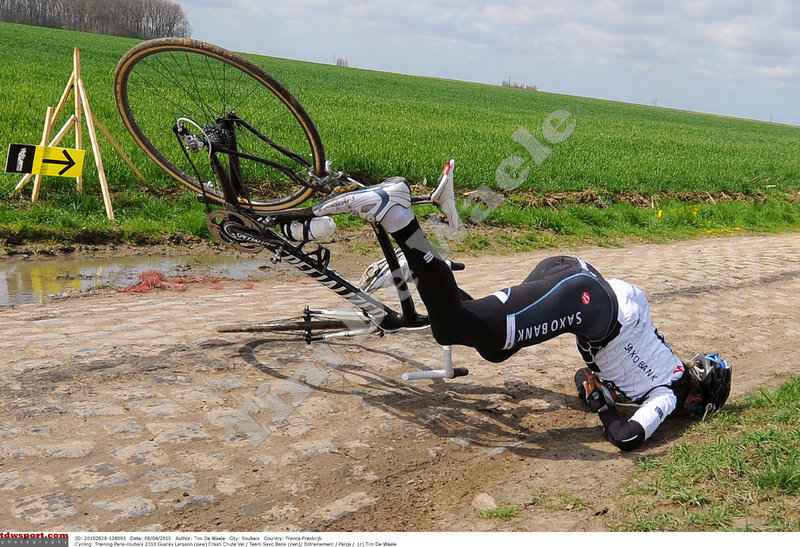
The cobbles in Paris-Roubaix are totally different than those at Flanders. The cobbles in Flanders are smaller and more squared, they are also located on a smooth surface with some sort of systematic plan behind them. They rattle your handlebars pretty bad still, coming into them at 60 km/h. The main difference though, is the space between the cobbles. While the cobbles in Flanders are pretty neat lined up, the cobbles in Paris-Roubaix seems like something kicked randomly out of the back of a truck (something they are). The distance between the cobbles combined the the sheer size of them, makes the difference. That, and the fact that this year's edition of Paris-Roubaix gives you total 51,5km of cobbled sections. Although the cobbles hit you after a solid 97,5km of cycling, they don't give you any chance of recuperating once they start. There are about five to six stones per meter, the vibrations shoots right through the legs, spine, arms, neck and shoulders so hard and so fast that blood does not circulate as freely as before, adding to the fatigue.

The cobbles are classified into based on difficulty by the race director. Two of the most famous cobbled sections, Trouée d'Arenberg and le Carrefour de l'Arbre, are both ranked highest difficulty.
It's not easy sitting on someone's wheel through the cobbled sections, at least not over those with the highest difficulty. You have to balance eyesight to drag and if there is one place you really need to watch your step, it is over these cobbles. If someone asked me to describe Paris-Roubaix with one word it would be brutal.

The fight
As you all know, the positioning before the cobbles is crucial, making the pace incredible fast the last 10km or so approaching the cobbles. Every captain will want to be at the front so the race is on with swearing, snorting and elbows several kilometres prior to the cobbles.

The margins

Downloaded here.

Favorites
Five stars: Tom Boonen, Pippo and Ballan - all performed very well last week at Flanders with Tommeke as the obvious fav. However, Paris-Roubaix doesn't care for favs so anything can happen.
Four stars: EBH, Thor Hushovd - Edvald Boasson Hagen performed well at Flanders and is even better at the flat cobbled race. Hushovd's has been struggling with disease but says his form is coming.
Three stars: Paolini, Sep Vanmarcke - Paolini is a strong rider in the classics, often not labeled a fav but has performed well lately. Sep is Garmin's hope, one of the few who has out sprinted Boonen (something Boonen is very aware of me thinks) and he has several good placings in semi-classics, making him a clear outsider to this year's Paris-Roubaix.

Normally, Cancellara, Leukemans, Breschel and Sagan would have been additional contenders but they are all out.

Summary
One of the season's absolute highlights is over us, several top contenders is out but who cares. This is the most brutal race of the season, totally unforgiving. And, one factor I haven't mentioned yet is the weather which can turn this race upside down. I say; bring it on.

Monday, 20 February 2012

BMC - the pressure is building

The World Tour circus has been ongoing for one and a half months now, travelling from Down Under to Asia and the Middle East. The riders have enjoyed some nice weather and been riding with their new kit, some with their new team for the very first time. Some teams have been winning "every race" (as I wrote here) while others have yet to open the champagne.

Worried yet?

Photo downloaded here.


Winning is contagious
Yesterday I talked to Mads Kaggestad, former Credit Agricole, on twitter. He mentioned that the pressure is now on for the big teams who have yet to win. I support this fully.
Of course, the riders on teams that haven't won anything yet will shrug the shoulders, look distant and say that "the season is still young" or that "the goals are the classics" and so forth. But, beneath all that, I suppose there is a tiny piece of uncertainty building. Nothing big, nothing you'll loose sleep over. Yet.

Thing is, big teams have big riders. Big riders get the support, meaning that "less experienced riders need to seize the possibilities", as Kaggestad said. So far they have not, meaning that the team's stars need to step up to do the job and win. After all, that is what they are paid to do.

Take BMC, having last years WC, tour winner, and rider of the year. The pressure on these guys is intense. Luckily, the three of them have been in the spotlight before and are familiar with pressure and how to deal with it. Have in mind, being mentally strong has nothing to do with being emotionless or "switched off", it is how you deal with pressure.

Solutions
There are many things one can do to deal with this, in my work I see this all of the time. Getting on the offensive and in that "zone" is critical, over-analyzing the preparations, the training and the team, are just some examples of how not to do it. Hopefully, staff and riders have been in situations like this before and have a strategy to cope with it or race coaches who are trained to work on these matters. Let's not forget another fact in favour of the stars; having adjusted your form during the better part of a decade helps too.

Summary
The season has been on-going for nearly two months now. Teams like OP-QS, Lotto, Sky and LIQ have all nailed a victory or three each, bringing the riders' shoulders down and creating smiles all around. Meanwhile, other big teams, like BMC has yet to prove themselves. This may lead to pressure building, both within the team, from sponsors and from fans. Will discipline remain? Who has the mental strength to perform? Only time will tell. 

Wednesday, 13 April 2011

Money talks - cycling and corporations

Some have just too much...
How is it possible to write about this subject without sounding like a character from the movie "Team America" or being perceived like a socialist? Not that there anything wrong with that of course.

The corporations are apparently a big concern among cycling fans. This morning I saw a debate on twitter by some journos and commentators and I felt the need to throw myself in that discussion too. I think the debate is needed and it is indeed appropriate due to last Sunday's Paris-Roubaix. I have never seen so many discussing whether Vaughters and Hushovd did their job or not by not giving Cancellara a helping hand up to the lead break. I have said mine about that episode, and I am still divided about what I mean about it.
A battle of emotions vs rationality if you like. And there are rules too, the powerful unwritten ones, I have to add.

Hushovd had one chance, when the lead break still was one break and Hushovd/Cancellara/Ballan was only 25 seconds down. But then again, I wasn't there, I don't know what Hushovd thought and now all that's left is speculations and history.
I guess I hadn't said mine after all... well, enough with that.

There are perspectives of course, and that is important to have in mind. Very little point in discussing if the parties discuss views from different perspectives. You are certain not to reach an agreement, a discussion can be entertaining based on different perspectives, by all means.

Cycling - is not a team sport   
That got your attention, no? I have written before that cycling is a team sport, no doubt about that. But is it possible that we have different perspectives here as well? On one hand we all have the notion that cycling is a romantic sport where the riders battle man versus man, where the strongest survives by attacking the other up the Gavia - the fans' perspective. Another perspective is the sponsor's: "Hey, here I paid millions of dollars and I want a return on that investment! Don't mess this one up!" In addition to this you have the riders' perspective, their dreams and goals. What about media's perspective, they who has the power to decide the agenda afterward? Which perspective shall be given the proper attention by whom? What perspective did Vaughters choose on Sunday?

A team manager has to win. It is not necessarily so that the team manager have special feelings for who shall stand on the very top of that podium. A win is a win. And from a team's as well as a sponsor's perspective, it is much better to have a winner in a race than a 3rd place. My point is that success mean different things to different people. And when sports are taken to a high enough level, the money rules.

Where is the cash return?
How is it possible most cycling teams are not able to earn cash? Not many team managers have a business background and that could be a disadvantage when the negotiations begin. Is it just me or have the number of wealthy businessmen investing in cycling increased the recent years? Is this because they don't have much to do or do they see a potential others don't? Flavio Becca, James Murdoch, Zdenek Bakala et al, are investors who want some return of their investment. What could that be? TV-time from a breakaway or a podium at Scheldeprijs? No, I don't think so. It could be that by controlling the team's legal aspect, one could control more than others, for instance like where and what sponsors to include where on jerseys, cars etc.
But cycling will likely end up like football (soccer for you American readers..), some rich investor want something to own and to make sure he gets something back, he will exploit every opportunity, turn every rock, to get some return on his/her investment. Part of that is to control risks.

Can I take it with me after the show? 


Photo downloaded here.

The downfall is that in the world of business, sometimes you don't get what you've paid for. Risk is you loose it all. Who will abandon ship first? That knows the businessman and the team manager. And besides, we saw what happened in December with Oz project Pegasus.

I think it is about time team managers and owners meet corporate rules with the exactly the same - corporate rules. Make demands, read carefully long-time business plans, take control as much as possible. With the brain as well as the heart. Many managers are ex-riders, nothing wrong with that, as long as they stick to being managers, all the way.

Summary
Cycling is indeed a team sport. As long as you refer to the executive part of it, from a team perspective. Those romantic days of individualistic heroics are not gone, but it's likely that they will occur more rare. Because corporate ideas are here now, and they have another dictionary of what "team" mean. At least to what purpose it is for. And as you all know, there is no "I" in team, is it?

Friday, 8 April 2011

Man vs machine - on the cobbles

The Queen of the Classics is soon over us and every team who have a desire to make a difference have already been out on the cobbles to reconnoitre the pavé. They have been doing all they possibly can prior to the race to test different tires, shifters, frames and forks. The tech-factor is unmistakable high this year, and both Cyclingnews and Velonews have many good articles out with pictures, found respectively here and here.

I'm not all that interested in tech myself. I'm on the level where I want my equipment to function properly, without ruining my experience on the road. My perspective is that I'm supposed to use it, not necessarily know all about it. What interest me though, is the difference in technological equipment teams utilise on the cobbles compared to other races.
Cycling has really become a technological arena where everybody is trying to get the better of their opponents. Chapeau to those engineers from SRAM, Campa and Shimano, dodging all teams who want the best and be alone with it. How do they sort that out? Money talks and personal relations are key.

Some time ago I interviewed Igor Turk, a Team Sky mechanic. I focused on the tech-aspect as well and how they prepared the bikes for the cobbles. You can read the post here.

Here are a couple pictures that indicates some of the tech-features teams and riders utilise before this year's Paris-Roubaix, for more pics check out the websites:


Notice the longer blades on Hincapie's fork, making it difficult for mud and dust to gather.


Photo by James Huang -downloaded on Cyclingnews- here 


Dura-Ace Di2 shifters are placed on the drops, some have "thumb-shifters" on the top of the handlebars.


Photo by James Huang - downloaded on Cyclingnews - here

Those were the days...? Eddy at the Lombardia


Picture downloaded at Pez cycling - here.


Friday, 25 March 2011

How Team Sky mechanics prepare the bikes for the Classics

The Classics season is all over us. Milan-San Remo took place last weekend, and now the hardest week of the entire season is due. Some 500km over treacherous cobbles in two days. I bet the riders are happy there is a mere week between the two, giving them just enough time to recover.
The Ronde van Vlaanderen or Vlaanderens mooiste (Flanders finest) and the Queen of the classics herself; the Paris-Roubaix are without doubt my favourite week of cycling, two of the very Monuments of cycling.

How do the different teams prepare? If you're doing one of the sportives right before one the two races, you might have asked yourself the same question. The recipe for success in the race as well as in the sportives is in the preparations. You might not do exactly like the pro teams but some similarities are there still. Few have the financial means to do so, fewer have the insight.

To find out more how teams prepare, I sent a request to Jonathan Turner, website editor of Team Sky, to interview one of Team Sky's mechanics. Team Sky is a team known have a good look for details, some says that eagerness to continually try to develop an edge destroyed their first season. There will always be a thin line in doing so, every team try to get that edge, in equipment, in training, in routines. The list goes on...


Jonathan was helpful to hook me up with Igor Turk (IT), one of the mechanics on duty during the cobbled classics this spring.   


PTR: Hi Igor, what is your background and how did you end up in Team Sky? 
IT: I started my cycling at age 11 as a junior rider and continued to ride up until 1995 (age26) when I become mechanic in the team where I was racing from the begining (Krka-Telekom/SVN team).

The team asked me if I was interested in being a mechanic and because I was not a real good rider, I accepted. I needed to learn a lot and was also working alone as I was the only mechanic for all kinds of  riders on that team.

In 2001 I went to the team Gerolsteiner where I was until the end of the team in 2008. While I was there with the team, it went from small team to a UCI ProTour Team. Again I learned many different things, especially in the first year.

PTR: What differ Team Sky form other teams you have worked with? 
IT: In 2009 I was then in team Milram before joining Sky in 2010. It was different straight away - the first meeting wasn't about days of work and money but the questions were on a different level, like how we if we work together in the team we make it better. If we become the best support team for riders, so they will perform better. In the team it's always communicated to us that the important thing is to do your very best.

Team Sky have also the first truck made with side pods which go out so mechanics and carers can work inside (if raining or hot weather), with AC and TV.


PTR: Guess that comes handy during warm days in summer. The cobbled classics are over us, how do you set up the bikes, special frames, handlebar tape and tires? 

IT: For cobbled races we have special frames, and also set up. 
First, in the handlebar we put near to the stem one more small brake end also buttons for shifting (riders grab handlebar in cobbles up, so they can brake and shift). We put double tape or some gel under the tape (depends what the riders prefer). Some of the riders change seat for a more soft one. Wheels we take classic (alu,no carbon) with 25-27 tires which have less pressure(normaly 9bar, here 7bar). Chainrings depends on the individual rider and how they ride on the cobbles (in which rpm).

PTR: Braking and shifting like a XC rider, how about that? Guess that is not for everyone.. How about damage to the bike?
IT:In cobbled races the damage is mostly flat tires, broken wheels (mostly the carbon ones), there are also lot more crashes (especially if is raining) so you can sometimes get a broken frame.

PTR: How are the mechanics team organised during a cobbled race and do you have mechanics whose special field is different from others?
IT: In the cobbled races we are mostly working the same way as in other races. However they are differences in that some of the mechanics or other members of team go with some spare wheels at various points agreed beforehand with the DS. It helps if our riders have a flat and the car with the race mechanic isn't right behind - or if the rider in question is behind the team car.

In the team all mechanics can cover all parts of the work, the only specialist field is in making wheels, some of mechanics are better at making wheels as to make a good wheel takes some experience for cobbled races. 

PTR: Back in the day teams like US Postal used to store the tires in a basement in France or Holland for years, to give the tires the proper moist and elasticity in hope to avoid flats. Do you do something similar with yours?
IT: In Gerolsteiner we also had something like this in our basement, for the big and important races, older tires they are much better and in some big Tours we didn’t have any flats.

Last year we were testing some more different brands. Now we've decided on Veloflex tires, we'll put some into store so that they get older and better.

Last year's collection of tires ready to be glued before Paris-Roubaix 2010. 100 tires were prepared.

Photo downloaded at www.michaelbarry.ca, here.


PTR: How will you describe the relationship between the mechanics and the representatives from the "mechanical" brands like Shimano et al? How do you keep track on R&D?
IT: I've worked with a few different brands: Campagnolo (Krka-Telekom), Shimano (Gerolsteiner), SRAM (Milram).

The longest time i spent with Shimano and I must say that they are the best to work with. They listen and try to make everything better, like sending engineers to races...we have realy good relationship with Shimano.

For staying on "top”of all new things in the bike industry it's mostly the internet, bike magazines, talking with other mechanics and presentations from Shimano. 

PTR: Well, thanks for taking the time Igor Turk, really appreciate it. Good luck in the cobbled classics.

Tuesday, 1 March 2011

What Hushovd really is doing in Arenberg Forest these days

What goals do you have Thor?


Photo by Wil Matthews, downloaded here.

As most probably know by now Thor Hushovd, the reigning World Champion, did not participate in Kuurne-Brussels-Kuurne. Yesterday Cycling Weekly could report that Hushovd is planning a reconnoitre of the last cobblestone sectors of this year's edition of Paris-Roubaix.

That is not entirely correct though.

Hushovd did travel to France this weekend, just after completing the Omloop Het Nieuwsblad, but he didn't only plan to reconnoitre with teammate Van Summeren and the new Classics DS expert Van Petegem, but to test some secret equipment.
Now what can that equipment be? To tell you the truth, I don't know what kind, but it is so secret that Hushovd's personal coach, Atle Kvålsvoll, only will tell what it is if tests prove good. I'm pretty good at speculating but I won't make a living out of it. Equipment could be anything, new Classic frame by Cervélo, new stem, pedals or even new tubes.

What an ideal place to test kit, the Paris-Roubaix is Hushovd's main goal for the season, others is RVV, the Tour and the Worlds in Copenhagen. With three peaks in his form, it's going to be an exciting season for the Norwegian World Champion. He said to France24 that his condition is great and that he believes to be in much better shape this year than last year, where he got to the podium at P-R.

Hushovd's dream of pedaling first into the Roubaix velodrome in his rainbow jersey, which The Bagder did in '81, could come true. It would be a nice birthday present to his personal coach as well.

The date to reserve is the 10th of April.


Did you see that Edvald?


Photo credit: From the Cycling Weekly article mentioned above.

Monday, 7 February 2011

How to ride the Queen of the Classics

Paris-Roubaix


Picture by Jered Gruber
Paris-Roubaix. The majestic race mean different things to different people. The race draws hundreds of thousands of international spectators and an even broader television audience. Some 270 kilometres on the roughest cobbled roads in the world, over six hours on the bike. Many riders fear the cobbles, knowing that their bodies will be beaten. The more experienced riders do not fear the cobbles but the panic they cause as the riders and teams battle for the lead positions before the sectors begin. The possibilities for grim conditions frame the races with a uncertainty the riders hate.

Riders train together for months prior to this and other classics, it takes time to establish the respect, trust and the experience needed to float over the cobbles as a team.

A win will change a rider's career for life, placing him in the history books, a better economic future and eternal fame. An attack can earn a rider respect, something the crowd appreciates, and it can keep a sponsor happy.

Everything can be lost in a second if the rider does not have the proper attention needed. A flat or a mechanical failure at a critical time, can make a rider loose the race. Most of the riders just try to survive the race, while a small number of riders give all they have on that particular day, in that particular week, for the glorious win. This week, the first in April, is probably the hardest week in cycling. Ronde van Vlaanderen, approximately 250 kilometres of cycling in Belgium and the Paris-Roubaix the weekend after, expose the riders for potentially pain beyond recognition.

Climbing can be brutal

Picture by Jered Gruber

The equipment
Mechanics prepare the bikes with meticulous accuracy, some bikes get two layers of handlebartape, some get three, just to give the riders a better shock absorbing ability. A thicker handlebar also make the rider not clinching the handlebar too tight when riding on the cobbles, this can cause problems with his arms as well as hampers the steering. Some riders tape their fingers as well, blisters can easily occur.
A tight bottle cage might come in handy as the cobbles easily can throw a bottle out.

Many use different bikes than the traditional road bike. A road bike is usual as stiff as possible, something that will make your journey over the cobbled sections a bumpy experience. A bike can absorb some of the shocks coming. but much can be done with a different geometry of the bike, not necessarily different materials. Different geometric also opens for a longer wheelbase, which again make the distance from wheels to crank larger than normal. This might come handy if the conditions are wet. The rain turns the sand into mud and if there's one thing you don't want into your gear system. Longer wheelbase also gives the riders a possibility to change the tubulars. Riders use thicker tubulars when riding on cobbles, normally around 27mm.

How to ride
Finding the least treacherous route is crucial, that could be on the top of the cobbles or at the side in the hard sand or grass. Since the roads have been used for many years by tractors the sides of the road are somewhat sunken while the middle of the road is peaked. The sides of the cobbled road could be full of potholes and large distances between the cobbles, adding the uncomfortableness.

When riding you will benefit from riding a bigger gear than normal. The tricks is to relax as much as possible while riding in those bigger gears, floating over the cobbled sectors. The first thing you should do when the cobbled sectors are done, unless you're on an attack, is to shift to those lighter gears, spinning the lactate acid out of the legs.

Washing off the Paris-Roubaix Grime

Picture by Jered Gruber

The showers at the Roubaix Velodrome are famous. The riders use them to rinse off the worst dirt, and they do so in the presence of other historical riders. The showers look like animal pen, the grim concrete look and the painting on the walls is falling off. On every pen, a small golden plaque states a winner's name and the year he won it. Apparently, Eddy Merckx' plaque is quite popular, it keeps getting stolen.

Tom Boonen once said that: "..when I stand in the showers at the Roubaix Velodrome, that's when I start preparing for next year's race."

That's it, the most prestigious Classic race in the world. The winner get a cobbled rock, his name on a golden plaque, but more importantly; a place among the very best of riders.


Jered Gruber was kind enough to give me his permit to use his pictures in this post. Check out more of his fantastic pictures on Flickr here.

Wednesday, 29 December 2010

Branding - why Rapha stands out in the crowd

In 1937 Dale Carnegie wrote a book called how to win friends and influence people. Not very humane and empathic for a title, is it? This is considered one of the first self-help books ever made, more importantly, it is considered a bible for communicators and marketing advisors still today.

Some brands are more catchy than others, as normal you might add. Why is it that some brands "get to us" more than others? We somehow identify with certain brands more than others. Who's choosing who?  No matter the answer, does it really matter? If cyclists are vain and by definition concerned by what they look like, it does matter.

My story

Three years ago I was on a plane reading an in-flight magazine. There was this small picture and a mere four lines about two friends who had started a cycling brand called Rapha, they specialised in quality clothing for the rider who wants the little extra. I took a note of that brand and decided to investigate further. And before you ask, no I don't own any stocks in the company, and I have never received anything I haven't paid full price for. What I enjoyed the most on their website was the stories. The stories about the nature of cycling, why the company was founded and those "epic" pictures taken by Ben Ingham that illustrated rides adding depth to the stories. And of course I like to think of myself as a guy who believes quality does matter. Basically I think the brand touched my feelings when it comes to cycling. The same feeling I got when I read the words of Phil Deeker's for the very first time (described in my very first blog post). This is what I relate to when it comes to cycling, and because of that I should be a part of it. On the other hand it could might as well been what I wanted to be a part of. To Simon Mottram, it probably doesn't matter as much but I like to think of myself to be as conscious as possible when I make my decisions.

What a brand Rapha has become. They are actually the best company I've known when it comes to branding, at least in the cycling industry. Today when globalisation is only a mouse-click away, branding is virtually impossible if you don't possess and/or deliver the life, goods or style you're claiming to have.

To me Rapha adds a further dimension celebrating the suffering in cycling. Like the ride celebrating the 100 years since the Tourmalet was first climbed in the Tour. Also the soon finished Rapha festive 500km which is set to enhance winter fitness during the food fiesta Christmas has become adds to the position Rapha's gained in the market. Very clever.


Not to mention the news concerning ASO and Rapha recently, where Rapha will be strategic marketing and product partner to ASO. This is of course a result to what Rapha has accomplished so far both product-wise but also their ability to share powerful stories cyclists can relate to. in today's world of information overload, only the ones with the strongest stories within their niche will survive.


I have some of their kit, and I'm very satisfied. I don't know if my bib or jersey are much more stylish than others, but I'm very comfortable with the quality of the products I have. I have tested some brands and I have to say that the quality Rapha gives is very good. If doing a blind test, would I know I'm wearing Rapha or Assos? Probably not. Maybe that proves I'm just a product of marketing managers and not that conscious I'd like to be.

To me simplicity and quality rules, but when the products are this pricey as they are, I might check elsewhere next time. But I know I'll get back to Rapha, if not to shop, but to get into their world by reading stories and look at the pictures.

Friday, 17 December 2010

History repeating itself?

Paris-Roubaix 1981 Bernard "The Bagder" Hinault had the rainbow jersey but somehow fell quite close to the finish. Apparently hitting a dog or just avoided it. After what for Hinault must have been some terrifying moments struggling on his own, he managed to catch up with the five other riders. Hinault was so calm that he actually went to the front of that little group into the velodrome and sprinted for victory from the very front. Nothing less than impressive.

Next year the God of Thunder Thor Hushovd has the rainbow jersey. After finishing the sprint in Geelong he was asked what his next goal was, the journalist probably didn't expected an answer at all in the moment of celebration. Hushovd on the other hand was crystal clear and proclaimed that winning Paris-Roubaix with the rainbow jersey on was next year's goal.
There will as always be a dogfight of dimensions in the race. As a Norwegian I would hope that he or any other Norwegian win, but I will cheer for everyone who enters and finish this brutal race. This race for sure shows the strong riders from the weak, there is no way you can win Paris-Roubaix without being in superb shape, like Fabian Cancellara proved this year.

When I wrote that history might repeat itself, I didn't mean that Hushovd should hit a dog and fall off his bike. There is no reason to make the race more exciting than it already is.

Looking forward to the 10th of April already. Atle Kvålsvoll, Hushovd's personal coach reminded me on twitter that Kvålsvoll has birthday this very day. Hushovd can make this a really memorable day, in many aspects.